
The intelligence layer for a facility that acts.
Nodes give a site senses and hands. Vigil gives it a mind: it learns what normal looks like for every reading, remembers everything that happens, sees trouble coming, and coordinates action — with a person approving every change.
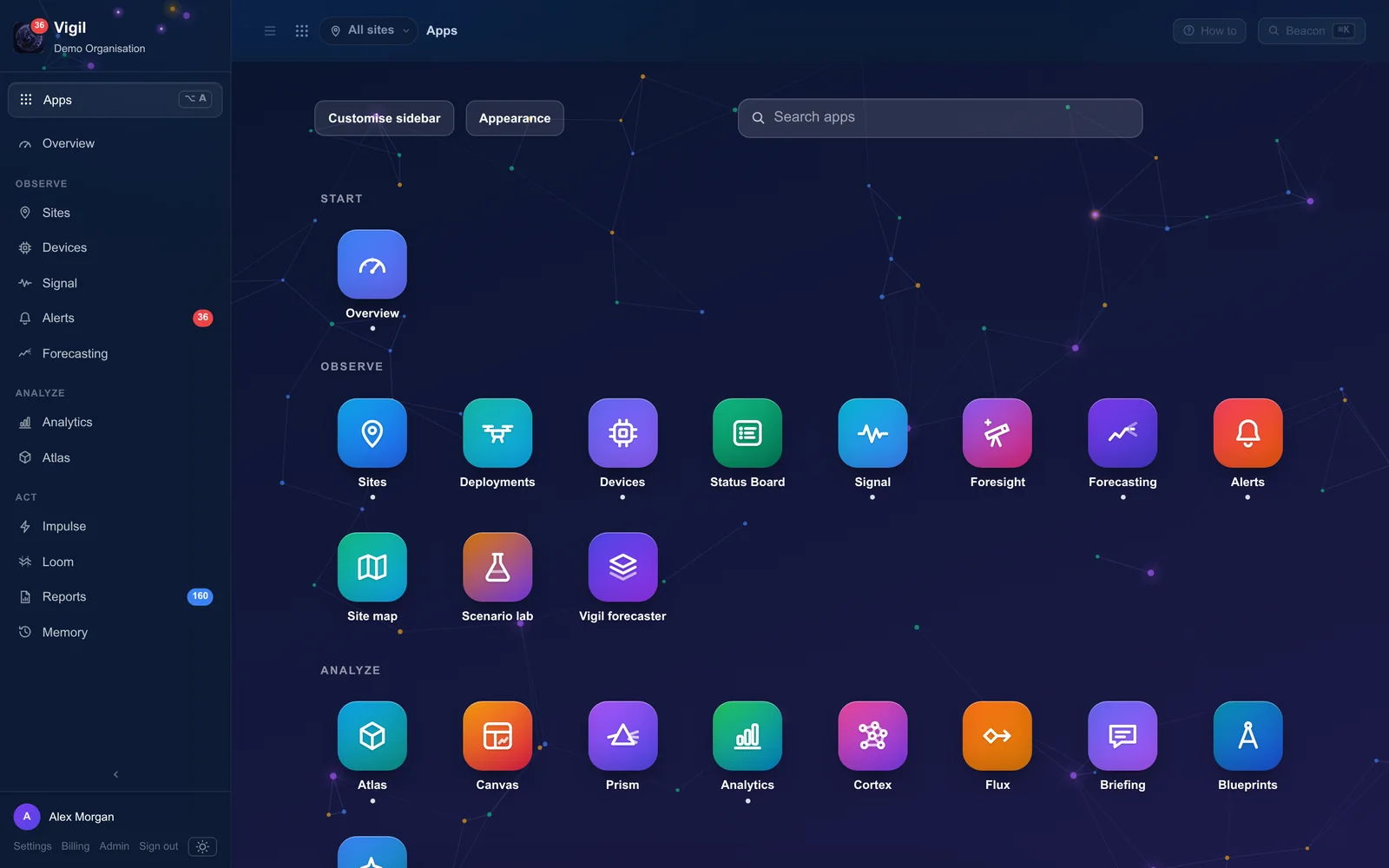
It learns what normal looks like — for every reading.
No thresholds to set. Vigil fits a normal band to every channel by itself — by time of day, by weekday and weekend — and notices when something steps outside it, drifts, freezes, goes quiet or gets noisy.
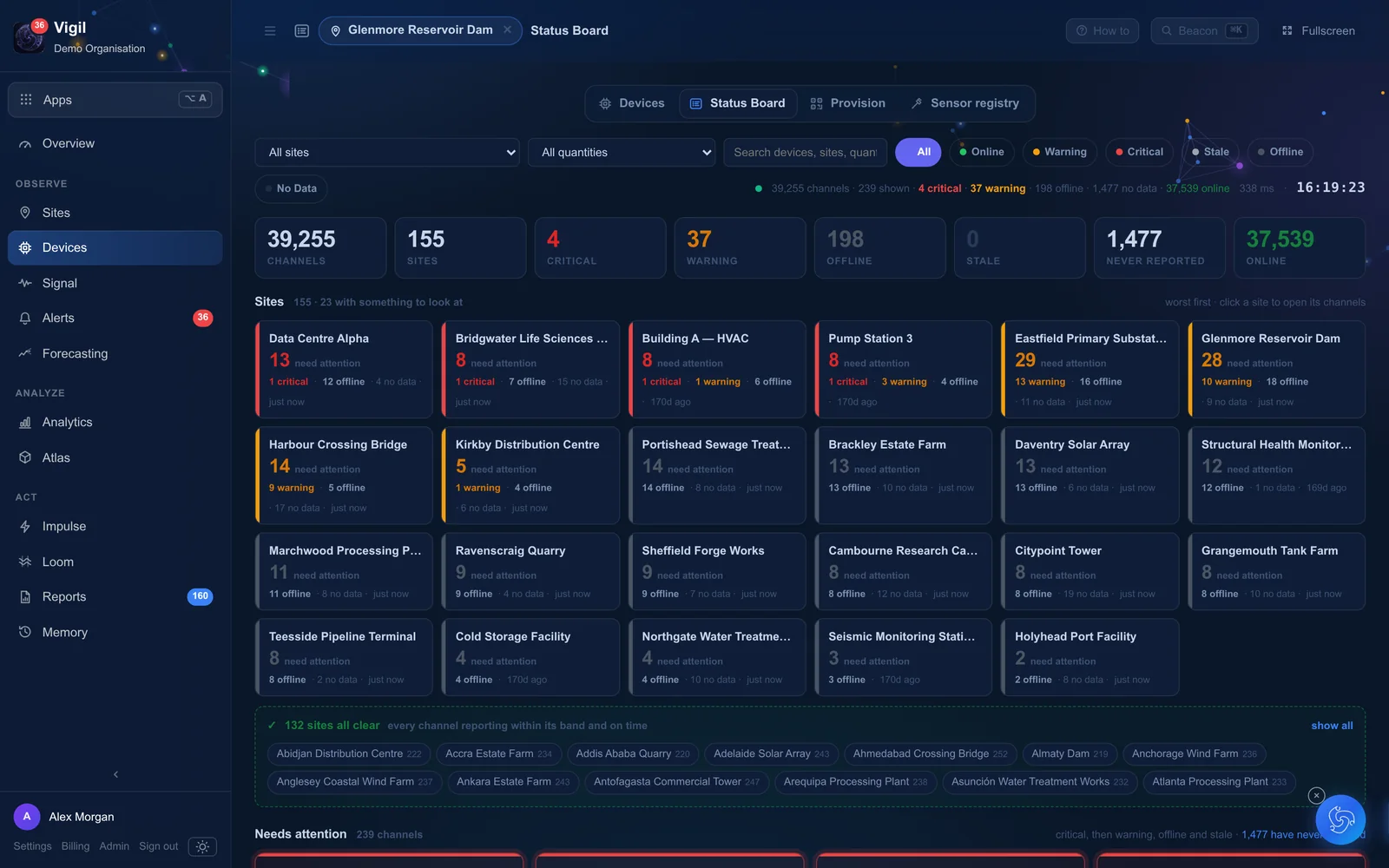
- Status board — the whole estate live, the cards that need someone first
- Signal — every channel, its band, its forecast, side by side
- Prism — new channels built from old ones: compensation, rates, cumulative damage
- Analytics — physics-based checks on machine and structural condition
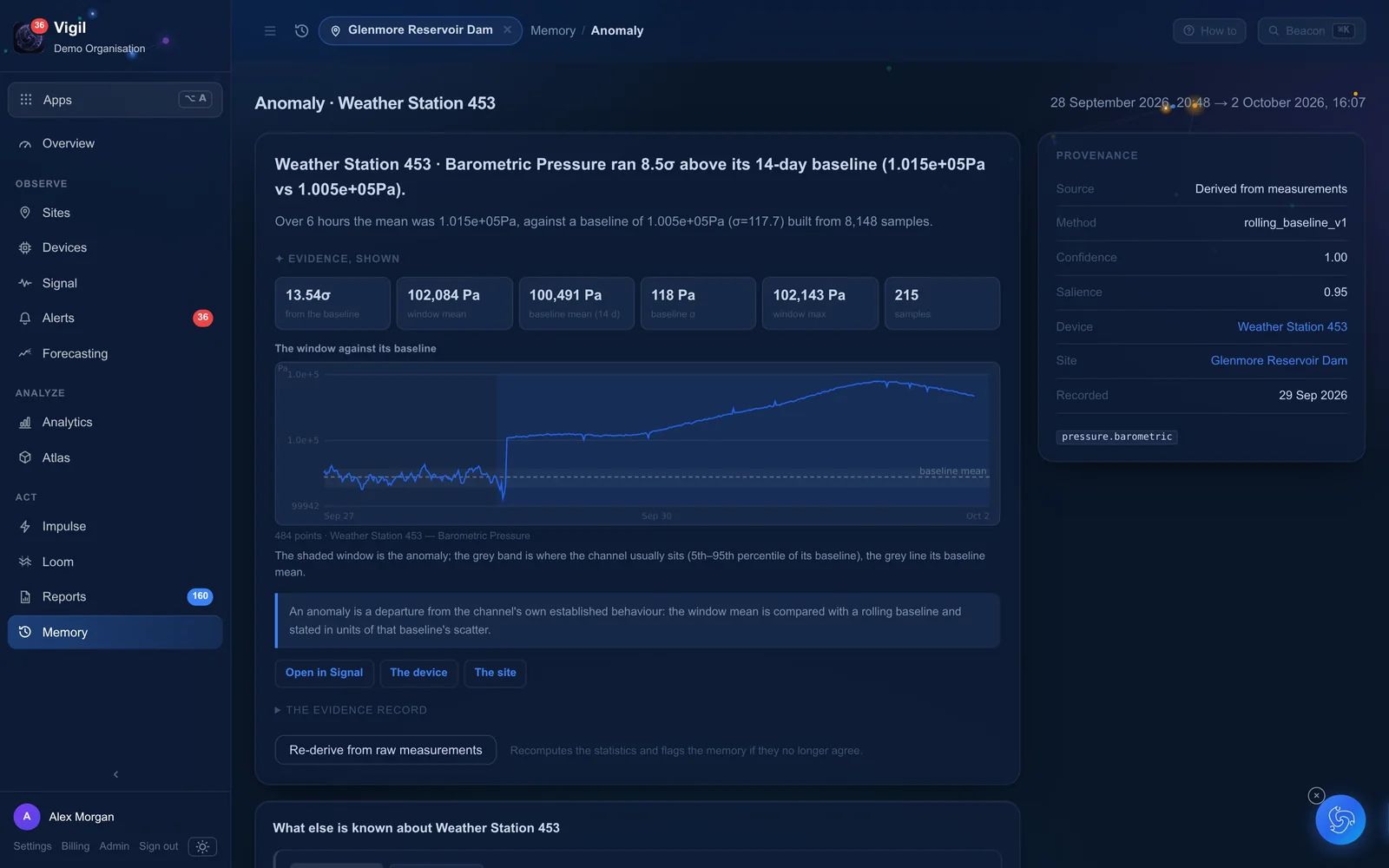
A site that never forgets.
Every finding, event, intervention and note becomes a memory on one timeline — each one saying who made it, the platform or a person, and when. Reports build on the last one; briefings tell a site's story in five questions; Argus reads it all.
- Memory — the institutional memory, with the evidence behind every entry
- Reports — questions first, verdicts computed from the numbers, carried forward
- Briefing — how is it now, what happened, what's next — every fact cited
Ask what happens next. Get a date, a chance and a reason.
Every channel is forecast, with bands calibrated on how the forecasts actually did. Foresight answers in plain words: which sensors are likely to cross a limit tonight, what happens if the weather turns, and how far to trust the answer.
- Foresight — questions in, answers with charts and the chance of every limit
- Scenario lab — what-ifs through the physics that drive each reading
- Predictive alerts — a warning before the crossing, not after it
- An engine that learns — it scores itself against what happened and adapts
Everything you look after, and how it all connects.
Atlas is the map of the physical things on a site — spans, pumps, transformers, rooms — what measures each, and how each is doing, with the reason in words. Cortex learns which readings move together, and notices when a coupling breaks or many things move at once.
- Atlas — assets with a health state: attention, watch or quiet
- Cortex — relations measured from the data; site-wide events spotted
- Relations in words — "this pump feeds that tank" helps the forecasts too
An assistant that does things — and asks first.
Argus knows your site. Ask it anything and it works it out step by step: it shows its plan, reads the data, draws the chart, and when the answer is an action — a rule, a report, a programme — it shows exactly what it will change and waits for your OK. Under every answer it says where the numbers came from.
- Argus — answers with charts and figures drawn from the data; never acts unasked
- Impulse — programmes that change how part of a site runs, then put it back
- Flux — reflexes: when this happens, do that — rehearsed before they go live
- Canvas — dashboards with controls that act on the site
- Loom — describe an analysis in words and get a workflow that runs it
At a desk, in a control room, beside the machine.
Beacon — one keystroke to any site, device or question.
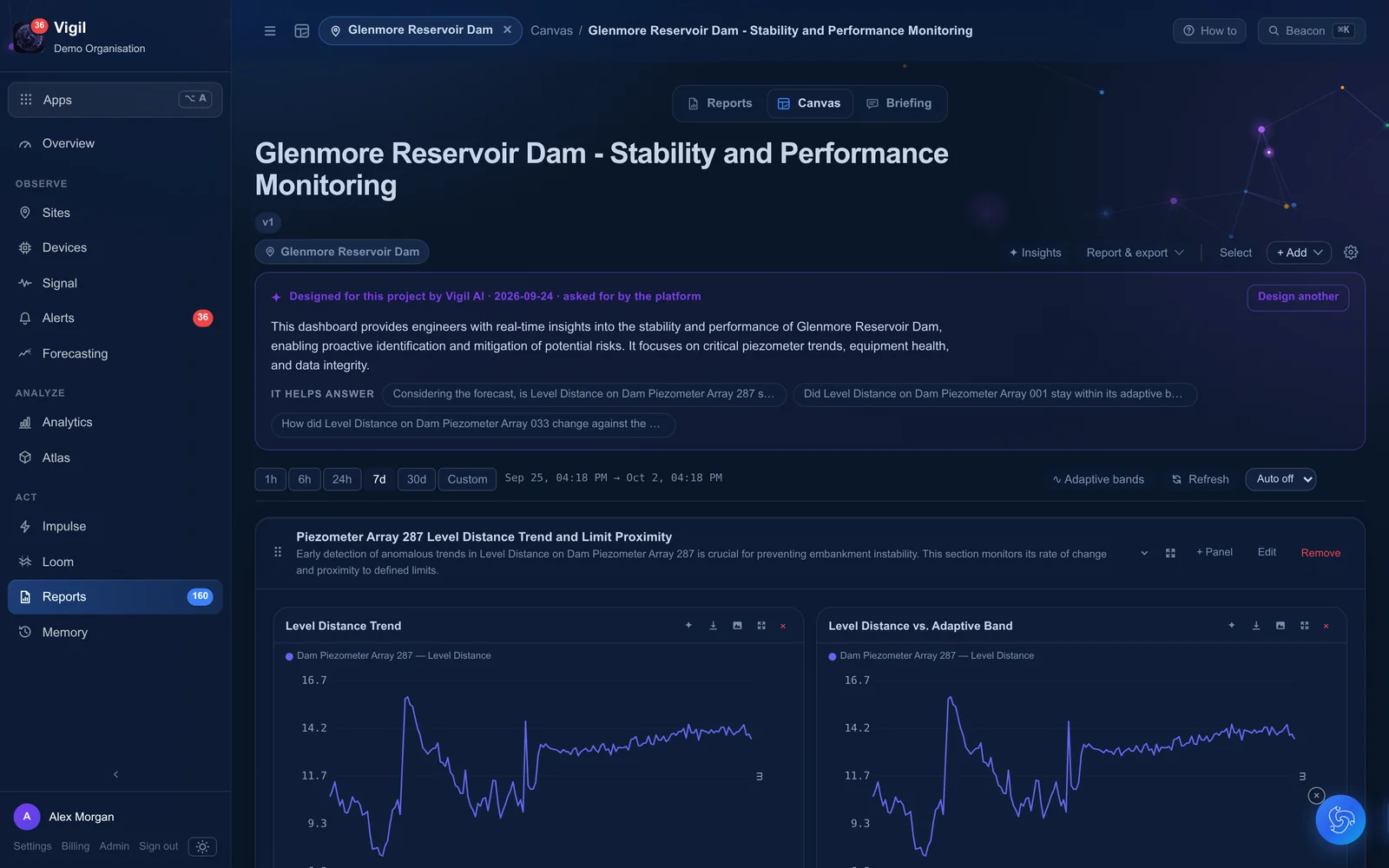
Canvas — every panel explained, with controls that act.
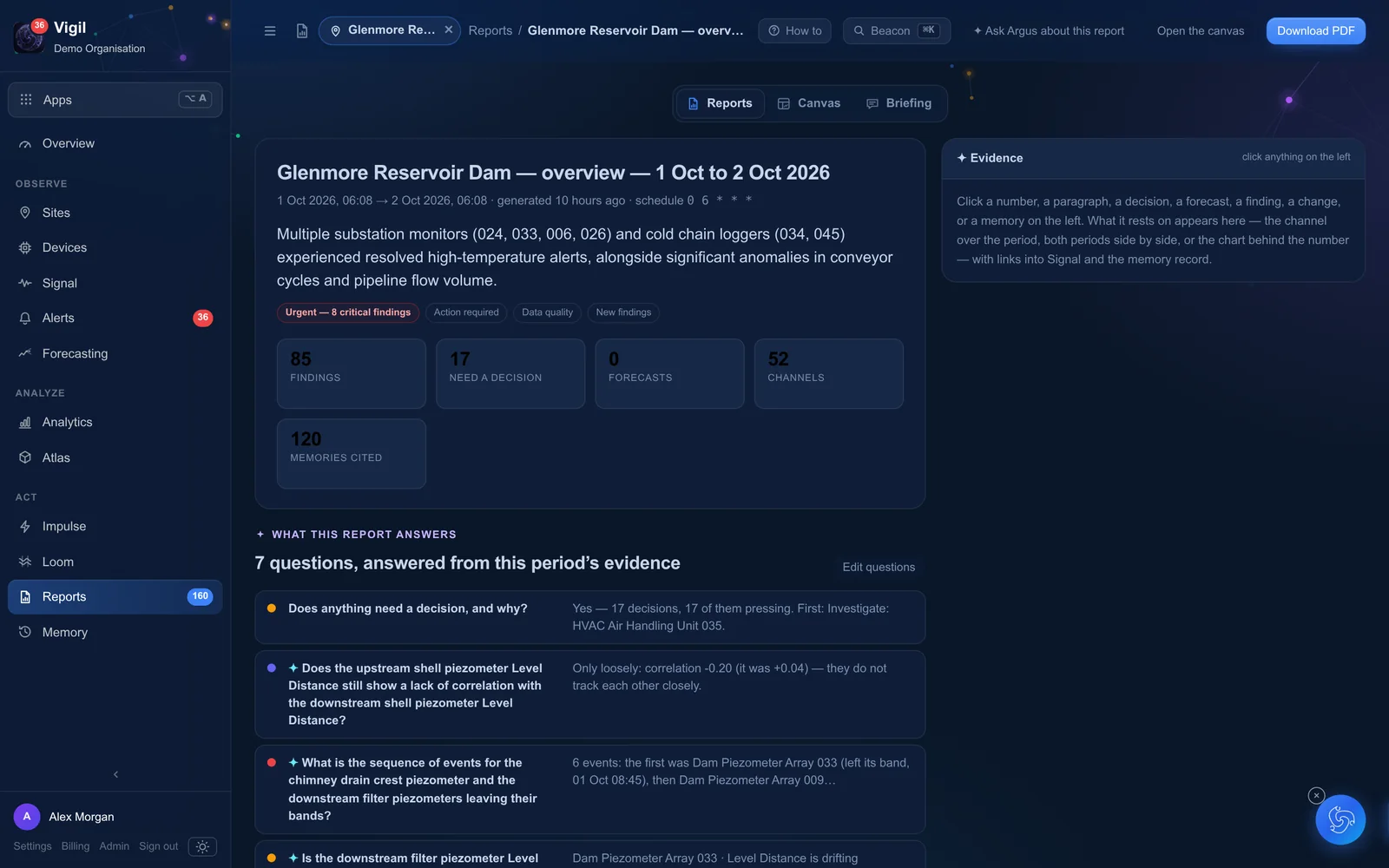
Reports — the questions that matter, answered from the numbers.
Strange behaviour, found without a single rule.
We test the platform the honest way: plant known faults in a labelled simulation of 108 sensor channels — next to channels left untouched — and count what it finds with no thresholds or rules configured. Longer reports find what a week can't: a slow creep, a sensor getting noisier, days that broke the usual pattern.
What it misses: small, slow drifts are the hardest case. Across all sources 9 of 12 drifting sensors were caught, but only 1 in 5 of the smallest; the two-week report names 7 of 12 by their steady creep. We're working on the rest.
From our behaviour benchmark (simulated channels, twelve per kind of fault). Your site will differ — a pilot measures it on your equipment.
Built for places where mistakes matter.
A person decides
Anything that changes the site waits for someone to approve it. Deletion and sharing always ask.
Provenance on everything
Every memory and every action says who — or which part of the platform — made it, and when.
Numbers checked
AI answers are checked against the data they read; anything unsupported is flagged, not hidden.
Private by design
The platform and its AI can run on your own hardware, so your data never has to leave your site.
Let's make sense of your site.
Tell us about a site — a plant, a dam, a campus, a cold store. We'll show you the platform on demo data like yours and plan a pilot with nodes on your equipment.