
Say what you need. Watch it built.
No dashboard to configure, no query language, no waiting weeks for an integrator. Ask in words, typed or spoken, and Vigil designs the view, fills it from your live sensors and tells you what it shows. Every figure comes from your sensors.
Dashboards built by asking.
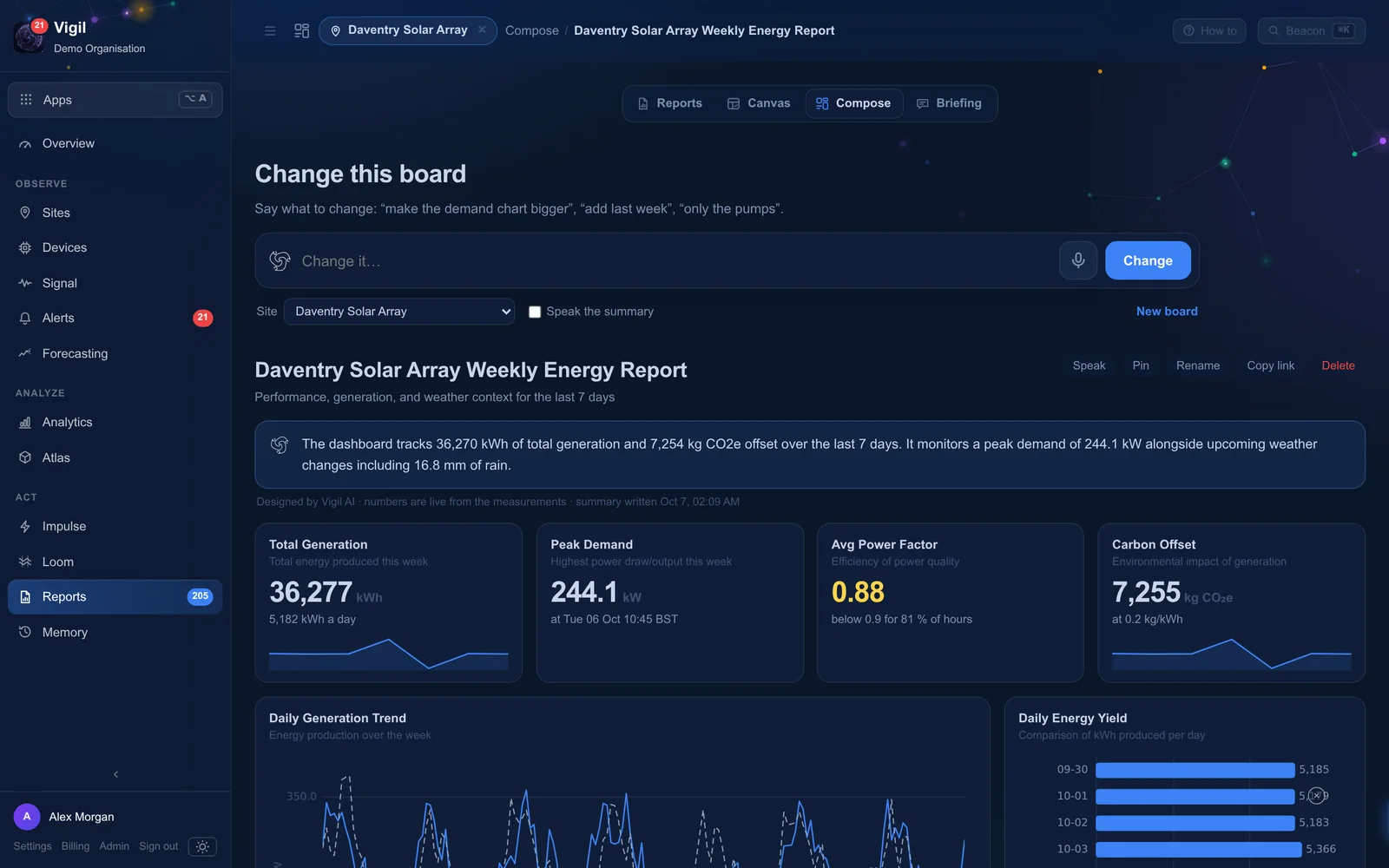
Describe the board you want. Compose picks the right blocks (figures, trends, heatmaps, rankings, forecasts, the weather, what the site already knows) and fills each one from your live data as you watch, block by block.
- The first block appears within seconds, not after a sprint
- Change it in words: "make that hourly", "add last week", "only the pumps"
- Understands energy, environmental limits, machine health and alarm load from the start
- Saved, shared and pinned like any dashboard, or put on a wall
- Every number traces back to the sensors that produced it
A voice for any room.
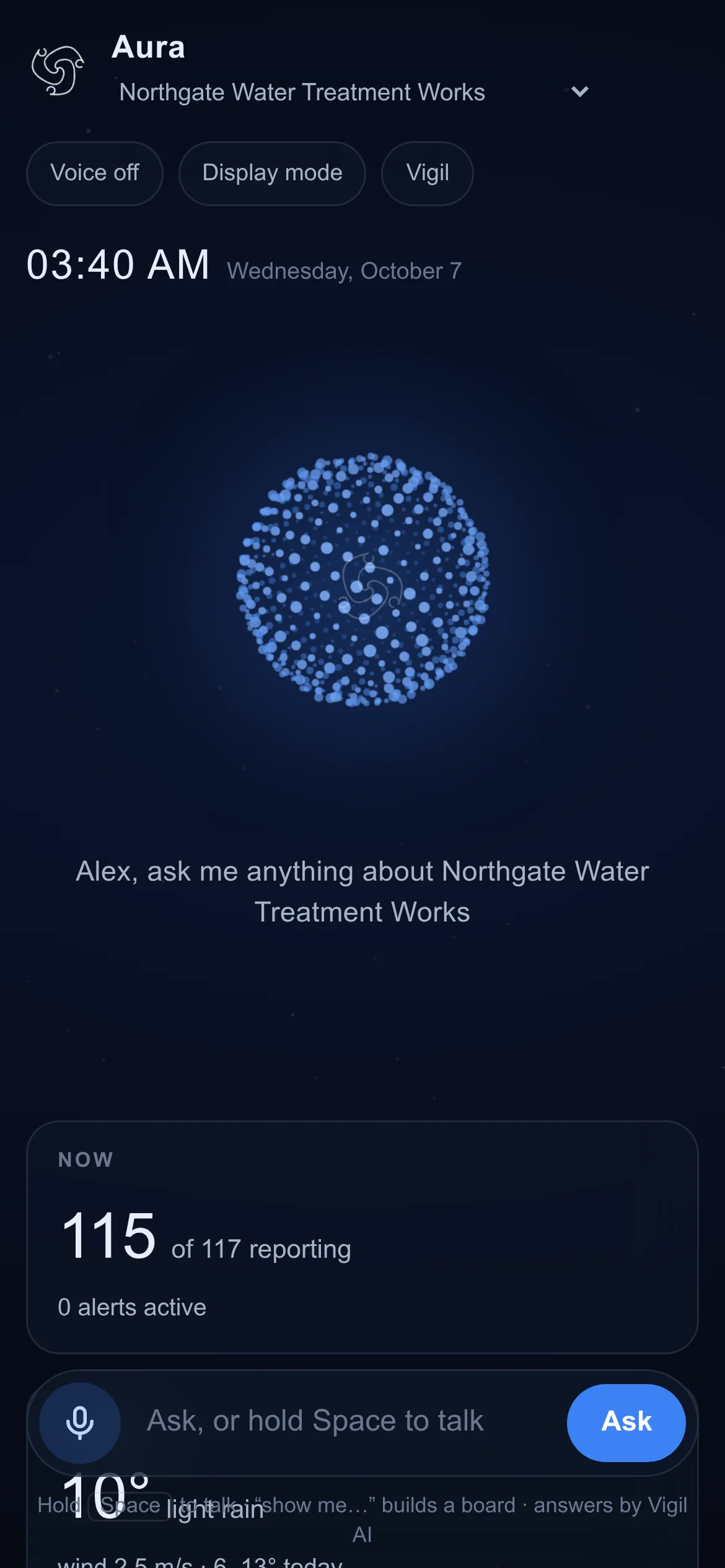
Aura turns a screen, a control room or a wall into a colleague you can talk to. Ask how the site is doing and hear the answer. Ask for a view and it slides in beside you. Around it is the site's pulse: what's reporting, what's open, the weather, and what is likely in the next twelve hours. It speaks up, once, when something matters.
- Made for the plant floor: hold to talk, or type when it is too loud to speak
- Speech is recognised and spoken on the platform's own servers, and audio is never stored
- Nothing changes by voice alone: anything Aura proposes waits for a person to approve it on screen
- A display mode for control rooms and walls, legible from across the room
Any question about a site, answered from the evidence.
Argus is the platform's AI colleague, with more than seventy tools: live readings and history, the site's memories and reports, forecasts, the knowledge graph and its drawings, alarms, energy, environmental limits and the local weather. It looks things up before it answers, and cites what it found.
"Where is our energy going out of hours?"
Baseload, the biggest consumers and the hours they run, normalised for the weather by degree days.
"Are we inside our permit this month?"
Air quality and noise against WHO and EPA guidelines or your own permit limits, with data capture and the weather on the days that broke.
"Which machines should we look at this week?"
Vibration zones to ISO 20816, run hours, starts and bearing temperatures, ranked by what deserves a visit.
"How hard are the alarms working the operators?"
Alarm rates against ISA-18.2: floods, chattering and stale alarms, the bad actors, and what to change first.
"What's upstream of FT-102?"
The knowledge graph built from your P&IDs: what feeds what, which loop an instrument belongs to, and which sensors measure each part.
"What did we learn last time this happened?"
The site's memory and the knowledge distilled from it: what recurs, what fixed it, and who wrote it down.
It only says what the data says.
- Numbers come from tools. A figure in an answer, a board or a spoken summary was returned by a query of your data, never written by the model on its own.
- It asks before it acts. A proposed change is a card a person approves, with what it will do and why.
- Model-read content is marked. A reading taken from a photo or a scan says so until a person checks it.
- Everything is on the record. Every question, answer and tool call is kept with the person who asked.
What a room needs.
Today, Aura runs in a browser: a screen, a keyboard or microphone, and a secure address for the platform. Walls run it in kiosk mode, on any small computer behind the display.
For rooms without a PC we are designing the Aura node: a far-field microphone array with echo cancellation, so it can hear you while it speaks; a wake word heard on the device, so nothing is sent until you call it; a hardware mute switch and a light whenever audio is going out; presence sensing to wake the screen; and a single cable for power and network.
Let's make sense of your site.
Tell us about a site — a plant, a dam, a campus, a cold store. We'll show you the platform on demo data like yours and plan a pilot with nodes on your equipment.