
The Vigil Node. Small enough to fit anywhere. Ready to act.
A wireless node that measures what's around it through plug-in probes, drives the equipment it's fitted to, and links to every other node on site. Thousands of them make a facility one distributed robot.
Everything a node needs. Nothing it doesn't.
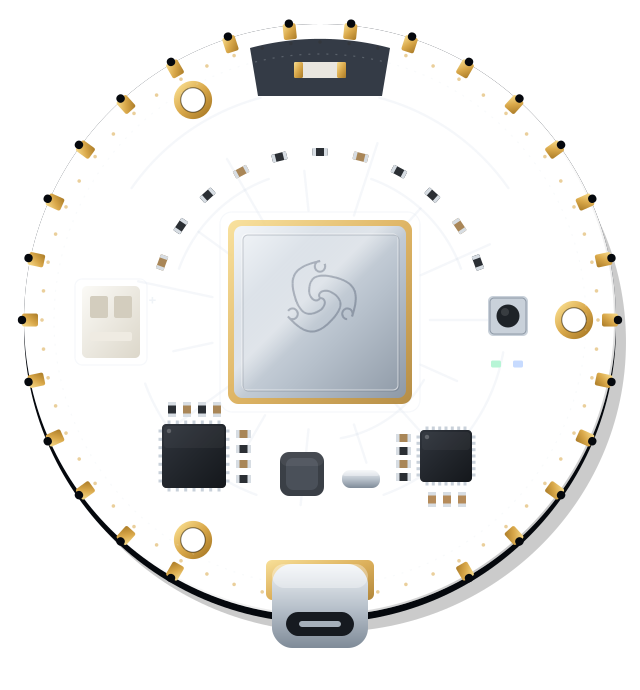
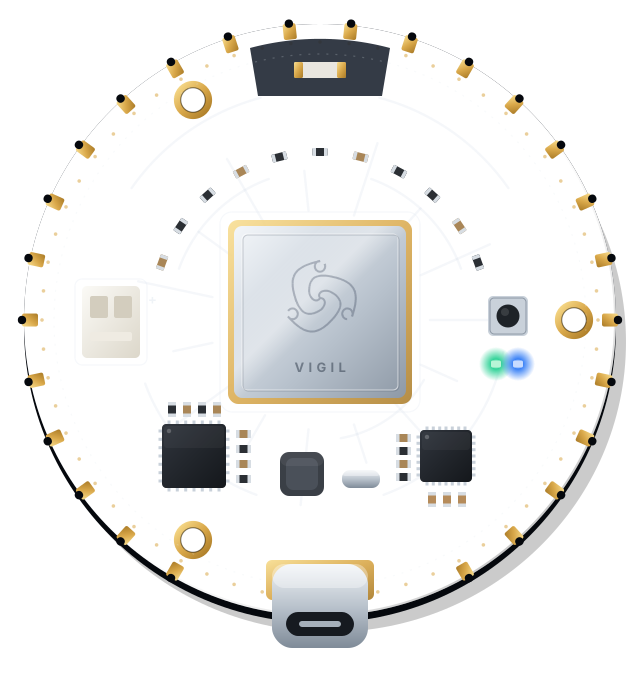
A finished board you can leave on a structure for the long run — shown here simplified.
Shielded wireless module
Low-power radio that links node to node, so coverage grows with every node you add.
Probe and output pads
Plug-in probes that introduce themselves, and outputs that drive relays, valves and dampers.
Status at a glance
Lights and buttons for the person standing next to it — the platform shows the rest.
Battery connector
Runs on its own battery, with on-board power management, where there's no mains.
USB-C
Power, charge or set it up on the bench with a single cable.
Mounting points
Fixes to a structure, an enclosure or a drone's perch payload.
Sense, act, connect — and fit into the platform from minute one.
Sense
Temperature, pressure, vibration, flow, current, gas, light, level — through probes that tell the node what they are.
Act
Outputs that move the equipment beside it, commanded by programmes, reflexes or a person — never silently.
Connect
Node-to-node wireless mesh across halls, yards, roofs and tunnels, out to a gateway.
Run on its own
Battery-powered with careful power management, or powered over USB-C where there's a socket.
Its own identity
Every node is known to the platform individually; every reading and every command it applies is attributed to it.
Changed remotely
Sampling rates and modes are set from the platform — a vibration watch, a quiet period — and put back afterwards.
Commissioned by phone
Scan its label, take a photo where it's fitted, and it appears on the site's map with its position and history.
Placed by drone
Perch drones carry a node to the exact spot planned on a 3D survey and leave it on its perch.
Plug in a probe. It introduces itself.
Probes carry their own description: what they measure, in which units, how they were calibrated. Connect one and the platform knows what it is — no configuration screens, no wrong units. The same probe works on every Vigil site.
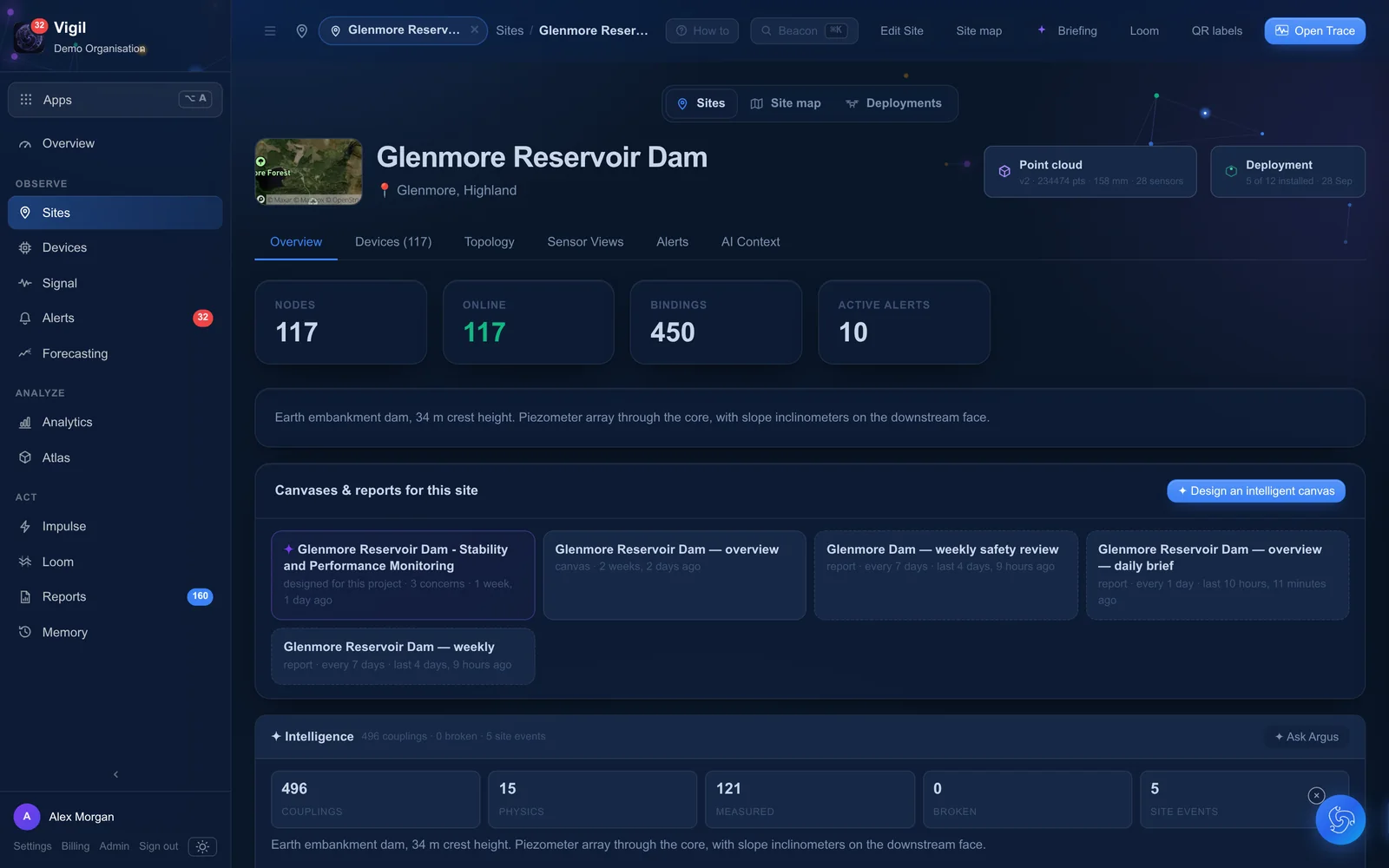
From a single probe to a whole site.
Probes
Self-describing sensors and actuators that plug into any node.
Vigil Nodes
Wireless nodes that measure, act and link into a mesh.
Gateways
Bring a site's mesh to the platform over the connection you have.
Perch
Drones that survey a structure and place nodes on it.
From first boards to the field.
The platform already runs end to end on demonstration sites with thousands of simulated nodes, including drone placements on full-scale survey models. The hardware is catching up fast.
The platform
Memory, forecasting, Atlas, Argus, reports, programmes and reflexes — running end to end on demonstration sites.
Perch deployment pipeline
3D survey, placement plan, flight order and commissioning, on full-scale demonstration structures.
Rev A boards in hand
The first Vigil Node boards arrived from manufacture. Bring-up and firmware are under way on the bench.
Pilot nodes on partner sites
Nodes on real equipment with our first design partners — sensing first, then actuation.
Renderings are illustrative and simplified; they are not a specification.
Let's make sense of your site.
Tell us about a site — a plant, a dam, a campus, a cold store. We'll show you the platform on demo data like yours and plan a pilot with nodes on your equipment.